KEY TAKEAWAYS
- Rated current is not an instantaneous trip threshold.
- Two 100 A fuses still require checks of AC/DC ratings, voltage, breaking capacity and operating curves.
- Physical fit alone does not establish compatibility with the holder or protection requirements.
Same amperes, different operating times
When a fuse operates, purchasing and maintenance teams often look for the same current rating. Matching amperes alone do not establish equivalent protection or replacement suitability.
Rated current is not a threshold above which a fuse opens immediately. Consult the model-specific time-current curve: different 100 A series may operate at different times under the same overcurrent.
Equipment starting can produce short current surges. A replacement must withstand normal starting while providing suitable fault protection. Faster is not always better; do not simply increase the current rating to stop repeated fuse operation.
An AC rating is not a DC rating
AC current periodically crosses zero, assisting arc extinction. DC lacks this natural current zero and has different interruption requirements.
A fuse marked 500 V AC, 100 A cannot be assumed suitable for a 500 V DC, 100 A circuit. The exact model must carry an applicable DC rating and meet the actual circuit conditions.
For products with both AC and DC ratings, check voltage, breaking capacity and operating conditions separately. DC applications also require checks of manufacturer limits such as circuit time constant.
| Marking | What to verify |
|---|---|
| 100 A | The current rating alone does not establish interchangeability. |
| 500 V AC | Do not infer an equivalent DC voltage rating. |
| Dual AC/DC ratings | Check the separate ratings and limitations for each circuit type. |
Check both voltage and breaking capacity
Voltage rating concerns arc extinction and recovery voltage during fault interruption. Breaking capacity is the maximum prospective fault current the fuse can safely interrupt under specified conditions. Neither is the normal operating current.
For the applicable AC or DC conditions, verify that the voltage rating covers the maximum circuit voltage and breaking capacity meets the prospective short-circuit current at the installation. Matching amperes or a higher voltage number alone does not prove compatibility.
Match protection to the equipment
Cables, transformers and power semiconductors have different protection requirements. Check the original duty, utilization category and curves rather than comparing only current and shape.
For equipment sensitive to fault energy, compare total-clearing I²t under equivalent conditions. Also verify coordination with upstream and downstream protection. A lower I²t figure alone does not establish a suitable replacement.
Physical fit is only part of compatibility
Similar-looking fuses can have different contact dimensions, mounting-hole spacing or connections. Check product drawings and equipment documentation. Forcing clips or altering mounting holes is not a substitute for compatibility checks.
- Cylindrical types: check overall length, body diameter and contact dimensions.
- Bolted types: check hole spacing, hole diameter, contact surfaces and specified tightening requirements.
- Striker-equipped types: check orientation, travel and compatibility with the operating mechanism.
- Check holder ratings, compartment temperature and ventilation against permitted power loss and manufacturer derating requirements.
RGS4 Bolted terminal
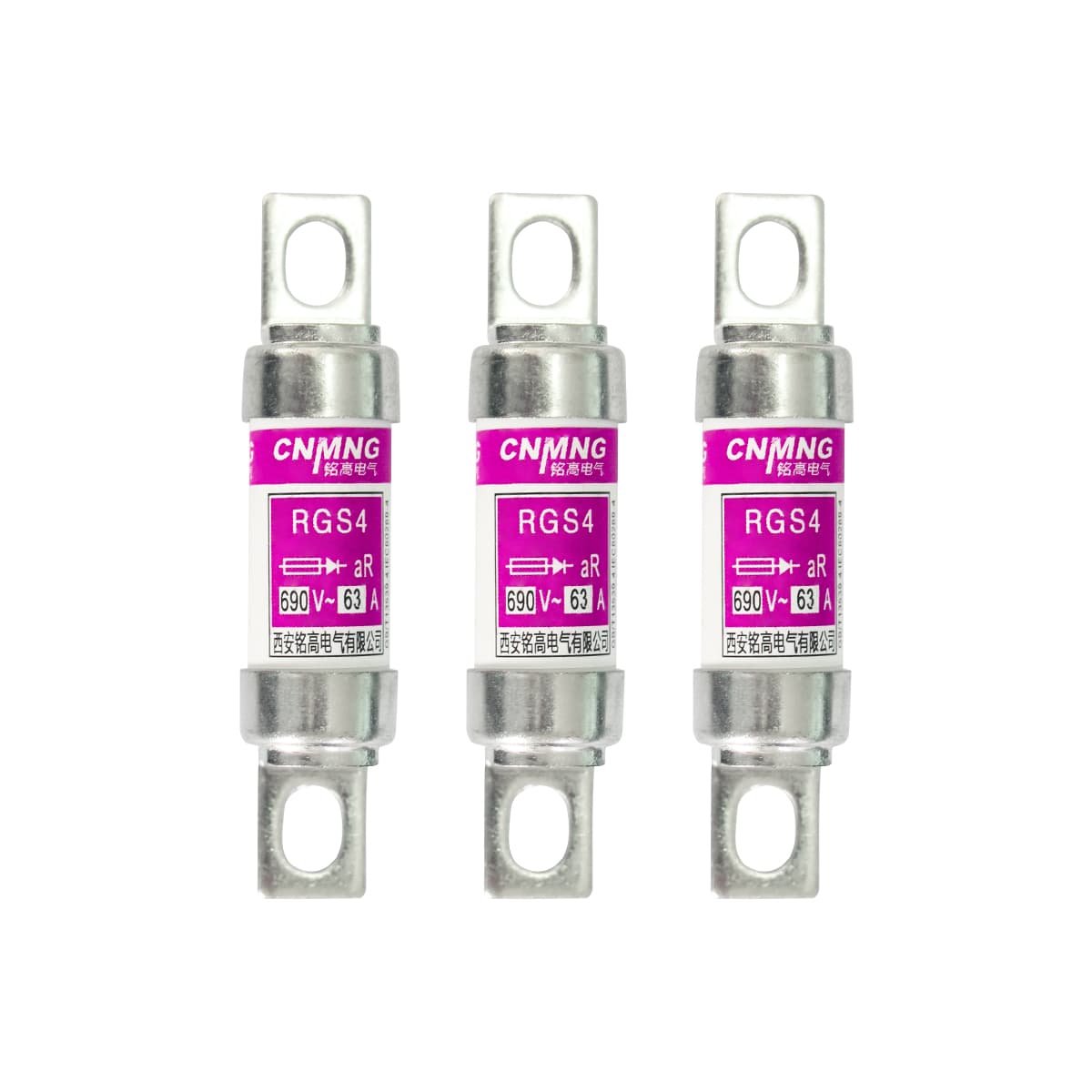
Check hole size, terminal thickness and contact surface.
NT00 Blade contact
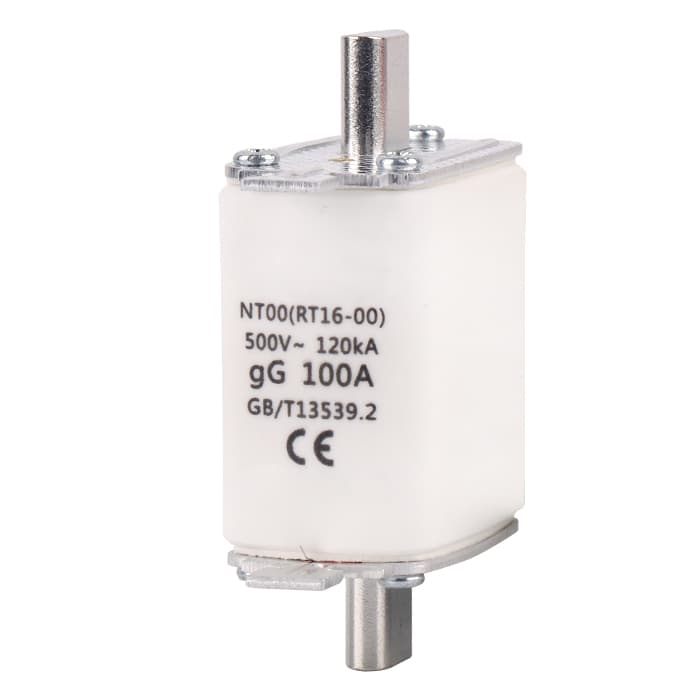
Check blade width, thickness and holder compatibility.
A practical replacement checklist
Investigate why the original fuse operated. Qualified personnel should isolate the supply, verify absence of voltage and discharge stored energy as required before replacement.
| Check | Information to prepare |
|---|---|
| Original product | Full model, manufacturer and a clear nameplate photograph. |
| Electrical ratings | Current, voltage, AC/DC ratings and breaking capacity. |
| Protection | Utilization category, time-current curves and, where relevant, I²t and breaking range. |
| Mounting | Drawings, contacts or hole spacing, holder and accessory details. |
| Operating conditions | Application, load characteristics, compartment temperature and ventilation. |
Not sure about a replacement? Send the complete details
For an enquiry, include nameplate and overall photographs, key dimensions, equipment application and quantity. These details are more useful than the current rating alone.
Minggao Electric can help review product parameters and mounting requirements using the original model and application details. Confirm the final replacement against equipment manufacturer requirements.
This checklist does not establish equivalence between any specific fuse models.